
The Woman Who Pickled Her Husband

My dear ones,
Are you sitting comfortably? There is a story to share with you, and it has been walking the old roads for many years. It has mud on its hem and salt in its seams.
Do not simply trust a story that revolves around the man. Often the man is the smoke but the woman, is the fire. This story has a woman’s handprint pressed deep into the grain of it.
You may have heard the version of this tale that has been dressed, for centuries, as the haunting of a village by a wronged, dead rector. But this story really belongs, as so many true things do, to the wife who survived him.
This is not the usual story everyone is told when they visit the village and ask about the name of the pub, The Pickled Parson. No, the true story came to me another way: passed from woman to woman, mouth to ear, across nearly three centuries, in kitchens, over childbirth and during long winter evenings, when the fire was low and one woman leaned in toward another and said: let me tell you what she actually said.
And so, it arrived at my hearth, the way such things always do. In the dark. With the weight of many hands upon it. And now it is a story for me to keep safe, then share when the time is right.
This is the truth that Mary Gamage told:
He died in August.
Which gave me four months to solve a problem that seemed to have no solution. I had no one I could tell, and my children were asleep upstairs. They did not know their world, as they knew it, had ended.
John died in the house we lived in for eleven months of the year; our house in Worcestershire, in White Ladies Aston, where the lanes were quiet and the orchards bountiful, and everything smelled of apple and old stone.
He had always preferred his life there. Rich living and socialising with men of consequence. Sedgefield was a duty. A living that paid well and required little, so long as he appeared in December to collect what was “owed to him” due to his station. He swept in and took, whilst managing not to offend anyone of consequence in the doing of it.
He was good at not offending people of consequence. He was less good at other things.
But I did not think of that in August.
In August, I sat beside him and held his hand while it cooled and was hit by a thought like lightening striking me: the tithes are due on the twentieth of December.
God forgive me. That was my thought, before he was cold.
Perhaps God already has forgiven me. I have had a long time to wonder if God even cares,since it was his own Church that... well… you see, the law was simple and merciless, as laws tend to be when written by men who will never be a widow thrust into the street with her children to starve. It was the law that if the rector did not collect his tithes on the appointed day; say, if he was dead, if his post was vacant, if his wife was sitting in a Worcestershire parlor with her grief and her arithmetic, then every penny passed to the Bishop of Durham. The Church would feed itself on our misfortune and call it procedure. I had seen it happen to others. I knew what it looked like. I knew what came after.
I was not going to let it happen to my children. He had to collect those tithes.
So, I thought. And, I thought. I could not tell you for how long.
I thought with a particular stillness that comes when panic has nowhere useful to go and must become something else instead. As the hours passed, that stillness hardened into the steel I needed. And by the time the candle had burned down, I knew what I had to do.
I told no one John was dead, because he could not be. I spread it about that he had been called away suddenly to attend to parish business. Even the servants were told this, just enough to explain and not make them suspicious. John was often away visiting one rich house or another. Nothing noteworthy in his being away.
And then I made my arrangements.
Salt! Practical women will tell you that things kept in salt may hold their shape through a cold autumn. I had a long road north ahead of me and a story to maintain for two hundred miles. So, I found a barrel and filled it. I put my husband in, surrounded by salt.
He was not a large man, but he never denied himself any the finer things that his indulgent life had to offer. In death, as in life, he was awkward. He was difficult to bend. He was near impossible to move, and there was a great deal more of him than there seemed when the barrel stood empty.
I worried that I could not pack enough salt around him.
But I was determined.
And John, for once, yielded.
I would tell the carrier it was “goods for the rectory”.
Which it was.
In a manner of speaking.
I knew, even then, that he would not like it.
John had strong opinions about propriety. About dignity. About the correct order of things and the appropriate behaviour of women, within that order.
He had rather fewer opinions about how his family might eat without him, that had always been a matter he was content to leave unexamined.
But the indignity of the barrel, the deception, the fact of being used, carried north like cured beef, propped in a chair like a puppet while his wife collected his money and smiled at his tenants…oh! I knew what John would make of that!
I considered it for perhaps…thirty seconds.
Then I sealed the barrel.
I will not tell you I felt nothing on that journey. I will tell you that what I felt was not what you might expect. There was grief in it, of course there was. John was my husband, and I had loved him once, I suppose, but my children would grow up without a father and the grief of that was a pebble in my stomach. But there was nothing good in letting it grow into a boulder to drag me down. I had to do the things that needed to be done to keep them safe.
Beneath it, around it and threaded through every hour of those long cold miles, there was something else. Something cold, bright and entirely my own.
I was doing it. I was solving it. With my own hands and my own mind and not a single soul to help me, I was going to keep my children fed.
The roads were hard. The weather turned in October and we came through Derbyshire in mud and sleeting rain. I sat in the cart with my hands folded in my lap like a woman, on a perfectly ordinary journey.
Behind me an impossible secret, silent and curled up in salt. An unthinkable cargo that gave us a chance. A briny act that I traded for the possibility of a future.
I smiled at the tollkeepers and I kept moving.
We arrived in Sedgefield in late November.
I settled the house. I spoke to the necessary people. I managed every question with the careful vagueness of a woman whose husband was simply very busy. I mentioned that he was somewhat unwell and did not want to be disturbed. No one cared. It was to my benefit that John was not missed at all. No one questioned me. Women who appear to be managing are unremarkable. It is one of the few advantages of being so thoroughly underestimated.
On the twentieth of December the farmers came with the tithe.
John, sat at the table in the dim room, a little distance away, like a man who did not wish to be troubled with unnecessary conversation. This was his nature with them anyway, and they saw nothing they did not expect to see. They asked after his health, as was polite. But John was not well liked and had been mostly absent from their lives; they didn’t ask more. They paid because they had no choice, and they resented every coin. Who could blame them? In previous years I had felt embarrassed by the taking of what was owed when naught had beengiven. But this year was different. This year, it was necessary.
They paid what they owed, and I gave them their receipts, and they went home to their wives and their fires, grumbling about the rich Reverend who cared not one jot for his flock.
The next morning I sent for the doctor.
He saw what I needed him to see. He looked at me strangely, and for a moment I thought I had been caught. Perhaps he did know. But he was a kindly man, and as I have said, John was not well liked. I looked him square in the eye. His face softened, and he signed what I needed him to sign.
John Gamage was declared dead. He had died suddenly. There was no cause for suspicion. I was a widow.
But my children were provided for. We would need to vacate the houses, yes, but the money was where it needed to be. I had breathing space to make a life for us, without John.
I had done it.
That night, the rectory changed.
At first a coldness in the passage between the house and the church, a heaviness to the dark that had not been there before. Doors opened when no hand had touched them. A sense, at the edges of a room, of something that had opinions and intended to express them.
John, it seemed, had come to Sedgefield after all. And he was furious.
I will admit I had not anticipated the haunting lasting quite so long. A few weeks, perhaps. Amonth or two of rattled windows and cold draughts and the particular atmosphere of a man making his displeasure known. That I could manage. I was only staying a matter of weeks, and I had been managing John’s displeasure for the better part of twenty years.
But John’s fury, it turned out, was not a temporary condition.
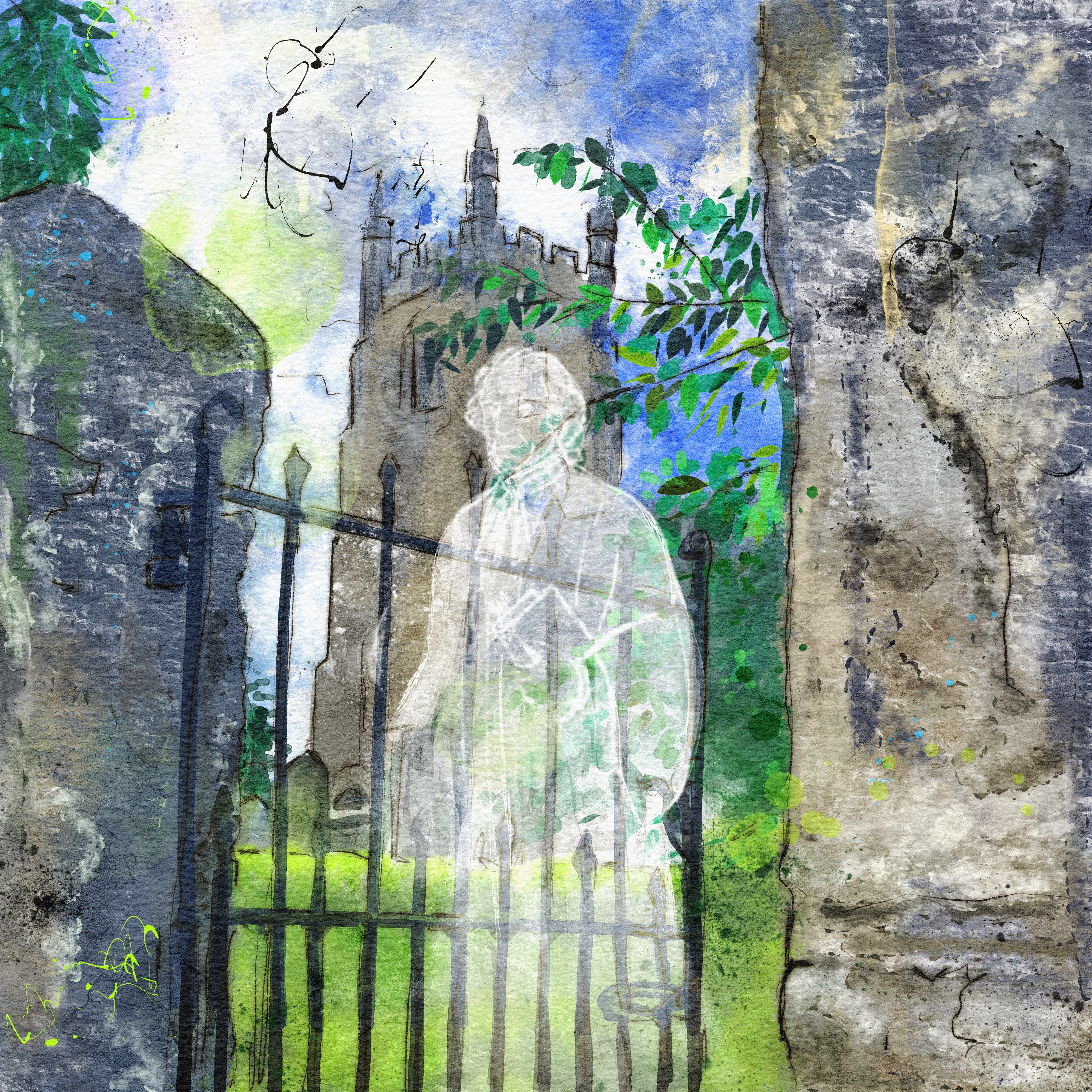
He walked that passage and haunted the rectory for forty-five years.
Forty-five years of making nights hideous, of cold spots and strange sounds, and the unmistakable presence of a man who felt he had been wronged and intended the world to know it.
The village got on with its life and stepped a little more quickly past the rectory after dark. Until a fire cleansed it all and haunting ceased.
What was he angry about, exactly?
That I had deceived the parish? No! He had drawn a comfortable salary from Sedgefield for decades while living somewhere else entirely.
That I had used him without his permission? Perhaps.
That I had won: that I had taken the situation he left me in, with no resources and no recourse and no one to help me, and I had solved it with my own two hands and I had done it without him. Using him, as a prop in my own scheme?
I think it was that, mostly.
I think John Gamage spent forty-five years furious that his wife had turned out to be so much more capable than he had ever needed to notice.
I will not pretend there was no cost to me in any of it. I carried that winter inside me for a long time afterwards, the weight of it, the silence of it, the fact of having held myself so perfectly still for so many months that I had almost forgotten how to move freely.
There are things you do to survive, that change the shape of you.
For nearly three hundred years, that story has been travelling, and now it has been told to you.
Mary learned that there is a kind of power that does not announce itself. It does not wait for permission, precedent, or someone to tell it what is possible.
There she was. She had a barrel. She had a road. She had children who needed feeding and a world that had made no provision for her. So, she made her own.
Sometimes we do not become powerful because we are ready. Sometimes we become powerful because the moment arrives and there is no one else in the room. There is a power in us that does not always look like power. Sometimes it arrives as stillness. Sometimes as calculation. Sometimes as the next necessary step, taken with shaking hands.
The world has called her a trickster, a deceiver, a woman of dubious character who had failed to behave appropriately in her grief.
But you do not need permission to become the person the moment requires.
“There are things you do to survive, that change the shape of you.”
The question is not whether survival changes us. It always does. The question is whether, afterwards, we will call that change damage, or initiation.
Panic runs in circles. Wisdom sits down, breathes and asks: what is the next true thing? Wise women learn that wisdom is the opposite of fear. If we make a little space around fear, wisdom may rise, up through the cracks.
Mary had answered the one question that has saved so many women throughout history: what needs doing, and what do I have to do it with?
So, ask yourself, be honest: where are you still waiting for the world to make things possible? And what might already be in your hands?
With love, from the Heartwood,
The Crone
This was a brilliant tale! Excellently written and truths ending the drama 'Panic runs in circles. Wisdom sits down, breathes and asks: what is the next true thing', and a little bit funny of course that in order to get herself out of a pickle she had to create a human one!
This is some of the best writing I’ve read in years